 Spanish
TL;DR:
- Passing a Spanish proficiency exam requires independently passing both reading and writing, and listening and speaking sections. Practice with official sample exams and focus on consistent daily study to build balanced language skills. Early speaking practice and understanding the exam structure prevent common preparation mistakes and improve success chances.
Passing a Spanish proficiency exam means demonstrating balanced competence across four core skills: reading, writing, listening, and speaking. These skills are grouped into two independent blocks, and you must meet the minimum passing threshold in each block separately. No amount of excellence in one group compensates for falling short in the other. Understanding this structure from day one is the single most important thing you can do to prepare for Spanish language certification.
How to pass a Spanish proficiency exam: format and scoring explained
The exam divides into two groups. Group 1 covers reading comprehension and written expression. Group 2 covers listening comprehension and oral expression. Candidates must score at least 30 out of 50 points in each group, with a combined minimum of 60 out of 100 to earn the diploma. That rule has a sharp edge: a near-perfect score in Group 1 cannot save you if you score 28 in Group 2.
Each section tests a distinct skill set. Reading tasks include multiple-choice comprehension questions, gap-fill exercises, and text-matching activities. Writing tasks require structured responses such as formal letters, opinion essays, or descriptive paragraphs. Listening tasks use recorded dialogues, news clips, and interviews. Speaking tasks assess your ability to describe images, discuss topics, and hold a conversation with an examiner.
| Section | Skill tested | Sample tasks | Points available |
|---|---|---|---|
| Reading | Comprehension | Multiple choice, text matching | 25 |
| Writing | Written expression | Essays, letters, summaries | 25 |
| Listening | Aural comprehension | Dialogues, news clips, interviews | 25 |
| Speaking | Oral expression | Image description, discussion | 25 |
The table above shows that each section carries equal weight. Neglecting any one area puts your certification at risk. Treat all four sections as equally demanding from the start of your preparation.
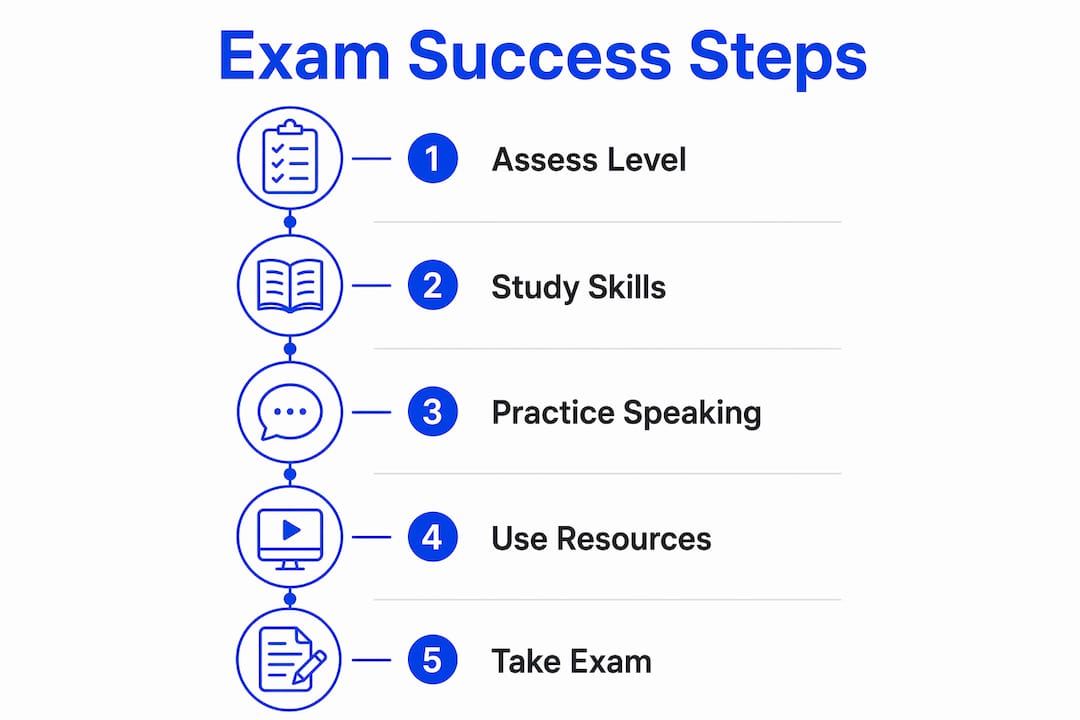
How do you assess your current Spanish level before studying?
Knowing where you stand before you start studying saves weeks of misdirected effort. A timed diagnostic practice test from an official source gives you the clearest picture of your current level. It simulates real exam conditions and reveals exactly which sections cost you the most points.
After completing a diagnostic test, analyze your results section by section rather than looking only at your total score. If your reading score is strong but your listening score is weak, your study plan needs to reflect that imbalance immediately. Setting a realistic proficiency goal based on your diagnostic score also helps you choose the right exam level to register for.
- Take a full timed practice test from Instituto Cervantes official materials before writing your study plan.
- Score each section separately and note which group (reading/writing or listening/speaking) is weaker.
- Set a target score for each section, not just an overall pass mark.
- Track your progress every two to three weeks using a fresh practice test or a focused section drill.
- Adjust your study plan based on your tracking results, not on how confident you feel.
Pro Tip: Record yourself speaking for two minutes on a familiar topic, then listen back. Most learners are surprised by the gaps between how they think they sound and how they actually sound. This simple exercise identifies pronunciation and fluency issues faster than any written test.
Reaching professional Spanish proficiency takes an estimated 600–750 classroom hours, but focused daily practice can compress that timeline significantly. Knowing your starting point lets you build a realistic schedule rather than guessing.
What study routine and techniques maximize exam success?
Consistency beats intensity every time. Daily practice of 20–30 minutes produces better fluency retention than occasional three-hour sessions. Neurological research supports spaced, regular learning because your brain consolidates language during rest periods between study sessions.
A balanced routine covers all four skills every week, not just the ones you enjoy. Many learners gravitate toward reading because it feels controllable. Speaking practice, by contrast, feels uncomfortable. That discomfort is exactly why you need to schedule it first.
- Monday and Wednesday: Focus on reading and writing. Work through a practice reading passage under timed conditions, then write a 150-word response to a prompt. Review grammar errors after each session.
- Tuesday and Thursday: Focus on listening. Use recordings that feature both Peninsular and Latin American Spanish. Listening comprehension accounts for roughly 25–30% of total exam scores, so varied accent exposure is not optional.
- Friday: Dedicate the full session to speaking. Practice with a tutor, a language exchange partner, or by recording yourself responding to exam-style prompts.
- Saturday: Do a mixed review. Revisit vocabulary from the week, complete a short grammar exercise, and listen to a podcast or radio clip in Spanish.
- Sunday: Rest or do passive exposure only. Watch a Spanish-language film or TV series without subtitles for the last 20 minutes.
Speaking practice should begin at the earliest stage of learning, even at a basic level. Native speakers value being understood over grammatical perfection. Focusing on communication rather than flawless sentences accelerates your progress and reduces the anxiety that derails many exam candidates in the oral section.
Pro Tip: Build a list of 200 high-frequency Spanish words and phrases specific to your exam level. Drilling these words in context, rather than in isolation, improves both vocabulary recall and spontaneous use during the speaking section.
Layering skills together produces faster results than studying each skill in isolation. Listening to a podcast and then writing a short summary of what you heard trains three skills at once: listening, vocabulary retention, and written expression. This kind of combined practice mirrors real exam conditions better than single-skill drills.
For a structured approach to building daily habits, the guide on daily Spanish practice routines offers evidence-based frameworks that fit around a working adult’s schedule.
What are the most common mistakes in exam preparation?
The most damaging mistake is treating the exam as a single test rather than two independent blocks. High scores in one group cannot offset failure in the other. Candidates who spend 80% of their study time on reading and writing often fail the listening section, even when their overall score looks acceptable on paper.
Balanced preparation is not about spending equal time on everything. It is about making sure neither group falls below the passing threshold. One weak group fails the entire exam, regardless of how strong the other group is.
- Neglecting listening variety: Practicing only with clear, standard-accent audio leaves you unprepared. Exam recordings use both Latin American and Peninsular Spanish, and the difference in speed and pronunciation can be significant.
- Prioritizing grammar over communication: Perfect grammar is not the goal. The speaking section rewards clear, connected communication. Candidates who pause to mentally construct perfect sentences often run out of time.
- Skipping timed practice: Completing exercises without a timer creates a false sense of readiness. Every section has a strict time limit, and running out of time is one of the most common reasons for low scores.
- Ignoring exam anxiety: Anxiety is a skill problem, not a personality problem. Regular timed mock tests reduce anxiety by making the exam format feel familiar rather than threatening.
- Studying in bursts: Cramming the week before the exam does not build fluency. Consistent study rhythms that fit your actual weekly schedule outperform ambitious plans that collapse after three days.
For practical advice on building your Spanish listening comprehension skills with varied accents, Spanish Explorer’s dedicated guide covers the techniques that matter most for exam conditions.
What resources support focused Spanish exam preparation?
Official materials from Instituto Cervantes are the non-negotiable foundation of any preparation plan. Instituto Cervantes provides sample exams and practice materials for every level from A1 to C2, covering all four exam sections. These materials reflect the actual exam format, task types, and difficulty level more accurately than any third-party resource.
Beyond official materials, a combination of resource types produces the best results. No single app or textbook covers all four skills equally well.
| Resource type | Best use | Skill targeted |
|---|---|---|
| Official Instituto Cervantes practice exams | Simulating real exam conditions | All four sections |
| Grammar reference textbooks | Structured grammar review and written accuracy | Reading, writing |
| Language exchange platforms | Conversational practice with native speakers | Speaking, listening |
| Spanish-language podcasts and radio | Accent variety and natural speech patterns | Listening |
| Online tutoring platforms | Personalized feedback on speaking and writing | Speaking, writing |
Language exchange platforms connect you with native speakers for free or low-cost conversation practice. Two to three sessions per week builds the spontaneous communication skills that the speaking section demands. Tutors who specialize in exam preparation add structured feedback that self-study cannot replicate.
For speaking practice ideas that work in Singapore’s context, the article on speaking practice methods covers both in-person and virtual options suited to busy adult learners.
Podcasts and radio programs from different Spanish-speaking countries solve the accent problem efficiently. Listening to Mexican, Argentine, and Spanish broadcasters in the same week exposes you to the full range of speech patterns the exam uses. Pair each listening session with a short written summary to reinforce vocabulary retention.
Key Takeaways
Passing a Spanish proficiency exam requires meeting the minimum score threshold in both the reading/writing group and the listening/speaking group independently, with no cross-compensation allowed.
| Point | Details |
|---|---|
| Two independent groups | You must score at least 30/50 in each group; a strong group cannot rescue a weak one. |
| Diagnostic testing first | Take a timed practice test before writing your study plan to identify real weaknesses. |
| Daily consistency wins | Short daily sessions of 20–30 minutes build fluency faster than infrequent long sessions. |
| Accent variety is mandatory | Practice listening with both Latin American and Peninsular Spanish to match exam conditions. |
| Official materials are essential | Instituto Cervantes sample exams are the most accurate reflection of real exam tasks and difficulty. |
What I’ve learned from watching adults prepare for Spanish certification
Most candidates underestimate the speaking section and overestimate how much reading practice transfers to oral fluency. I’ve seen learners with strong written Spanish freeze completely during a timed speaking task because they had never practiced under pressure. The solution is not more vocabulary. It is more reps under realistic conditions.
The other pattern I see repeatedly is the “one more week” trap. Learners delay registering for the exam because they don’t feel ready. That feeling rarely goes away on its own. Setting a registration date first and building your study plan backward from that date creates the accountability that keeps preparation on track.
Speaking anxiety is real, but it responds to exposure, not avoidance. Starting conversational Spanish practice early, even with basic phrases, builds the mental habit of thinking in Spanish rather than translating from English. That shift is what separates candidates who pass the oral section from those who struggle despite knowing the grammar.
Individualized feedback from a certified instructor accelerates progress in ways that self-study cannot match. A tutor who has seen hundreds of exam candidates knows exactly which errors cost points and which ones examiners overlook. That knowledge is worth more than any app subscription.
— Paul
Spanish Explorer’s adult courses for exam preparation
Spanish Explorer offers adult Spanish courses in Singapore designed for conversational fluency and professional use, with structured preparation for Spanish language certification exams.
The school’s curriculum aligns with international proficiency standards, covering all four exam skills through certified instruction. Private classes give you personalized feedback on your weakest areas, whether that is written accuracy, spoken fluency, or listening comprehension. Online Zoom classes offer the same structured instruction with the flexibility of learning from anywhere. Corporate training programs are also available for teams building professional Spanish communication skills. For a full overview of available courses and formats, visit the Spanish courses page to find the option that fits your schedule and certification goals.
FAQ
What is the minimum score to pass a Spanish proficiency exam?
Candidates must score at least 30 out of 50 points in each of the two exam groups, reaching a combined minimum of 60 out of 100. A high score in one group cannot compensate for failing the other.
How long does it take to prepare for a Spanish proficiency exam?
Preparation time depends on your current level and target exam level. Reaching professional proficiency takes an estimated 600–750 classroom hours, but focused daily practice can compress that timeline to 6–12 months for conversational fluency.
What is the best way to practice for the listening section?
Practice with recordings that feature both Latin American and Peninsular Spanish accents, since the exam uses varied regional speech. Listening comprehension accounts for roughly 25–30% of total exam scores, making accent exposure a critical part of preparation.
Should I focus on grammar or communication for the speaking section?
Focus on communication. Native speakers and examiners value being understood over grammatical perfection, and speaking practice should begin as early as possible to build spontaneous expression rather than translated responses.
Where can I find official Spanish proficiency exam practice materials?
Instituto Cervantes provides official sample exams and preparation materials for every level from A1 to C2. These are the most accurate resources available and should form the foundation of any serious preparation plan.
Recommended
- Spanish Language Proficiency Levels Explained for Adults
- DELE Exam and Spanish Proficiency: A Complete 2026 Guide
- Why Study Spanish in 2026: Benefits Worth Knowing
Start Learning Spanish Today
Book a trial class and see how quickly you can progress with a professionally trained native-speaker teacher guiding the way.
Book a Trial Class