 Spanish
TL;DR:
- The CEFR categorizes Spanish proficiency into six levels from A1 to C2, based on functional abilities rather than grammar rules. It helps learners and educators set clear goals, measure progress, and align with recognized exams like DELE. Reaching B2, which involves around 4,000 words, typically requires 400 to 600 hours of focused study and indicates conversational fluency.
The Common European Framework of Reference for Languages, known as CEFR, is a standardized system that defines Spanish proficiency across six levels from A1 to C2. Understanding what is CEFR for Spanish means understanding a universal language that educators, employers, and learners all speak. The Council of Europe introduced the CEFR in 2001 and updated it in 2020 with expanded descriptors covering online interaction and mediation skills. The framework measures what you can actually do with Spanish, not how many grammar rules you have memorized.
What are the CEFR levels for Spanish?
The CEFR organizes Spanish proficiency into three broad bands: A (Basic), B (Independent), and C (Proficient). Each band splits into two levels, giving you six total stages of development. The system is built around functional “can-do” statements that describe communicative ability across speaking, listening, reading, writing, and interaction.
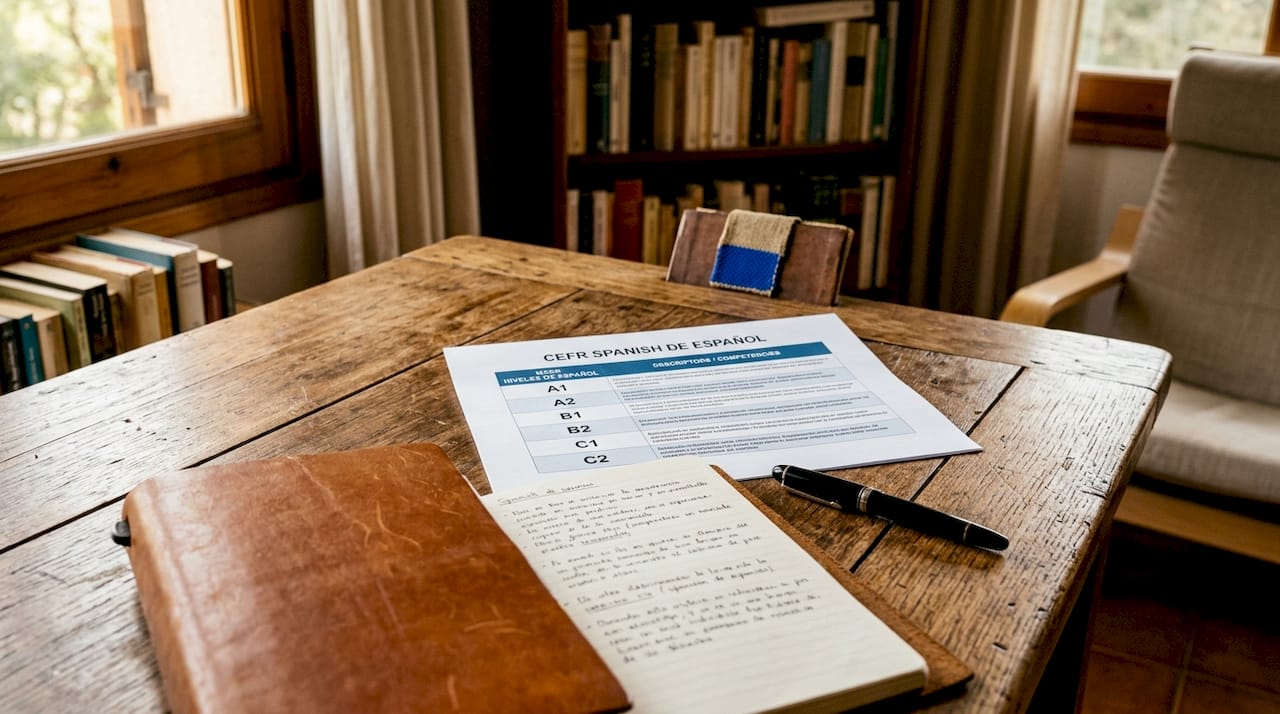
Here is what each level looks like in practice:
| CEFR Level | Label | Vocabulary Size | Real-Life Ability |
|---|---|---|---|
| A1 | Beginner | ~500 words | Introduce yourself, order food, ask for directions |
| A2 | Elementary | ~1,000 words | Discuss daily routines, handle simple transactions |
| B1 | Intermediate | ~2,000 words | Travel independently, express opinions on familiar topics |
| B2 | Upper Intermediate | ~4,000 words | Hold professional conversations, understand most media |
| C1 | Advanced | ~8,000 words | Use Spanish fluently in academic and professional settings |
| C2 | Mastery | ~16,000 words | Understand virtually everything, including idioms and nuance |
Vocabulary size grows exponentially across the levels. Mastery at C2 requires up to 16,000 words, including idiomatic and colloquial usage that no textbook fully covers.
The “can-do” approach is what separates CEFR from older grammar-based systems. At A1, you can greet someone and state your name. At B1, you can handle most situations while traveling in a Spanish-speaking country. At C1, you can express ideas fluently and spontaneously without searching for words. Each level builds on the last in a logical, measurable way.
Pro Tip: When you assess your current level, focus on what you can do comfortably, not what you have studied. CEFR measures performance, not exposure.
How does CEFR help learners and educators set Spanish goals?
CEFR gives both learners and educators a shared language for measuring progress. Without a common reference point, “intermediate Spanish” means something different to every teacher and every learner. The CEFR solves that problem by anchoring progress to specific, observable behaviors.
For educators, CEFR descriptors guide curriculum design by defining clear, measurable objectives based on functional language use rather than rote memorization. A teacher designing a B1 course knows exactly which speaking tasks, reading texts, and listening exercises belong at that level. This makes lesson planning faster and assessment more consistent.
For learners, CEFR works as a personal roadmap. You can use it to:
- Identify your current level through a placement test or self-assessment checklist
- Set a realistic target level based on your professional or personal goals
- Choose textbooks, podcasts, and courses calibrated to your stage
- Track progress by revisiting “can-do” statements every few months
- Align your learning with Spanish language pathways that match your timeline
The CEFR is also test-agnostic, meaning it does not belong to any single exam. It serves as a universal reference that multiple Spanish proficiency tests align to, including the DELE administered by Instituto Cervantes. That universality makes your level transferable across countries, employers, and academic institutions.
Pro Tip: Set your CEFR goal one level above your current stage, not two. Jumping from A2 to C1 as a target creates frustration. Jumping from A2 to B1 creates momentum.
What does fluency mean within the CEFR for Spanish?
Fluency is one of the most misused words in language learning. Within the CEFR framework, B2 is the standard for conversational fluency. At B2, you can interact with native speakers without strain, understand most television and news content, and hold professional conversations on a wide range of topics.
“Fluency does not mean perfection. At B2, you will still make errors. What changes is that those errors no longer block communication. You think in Spanish, not in translation.”
That distinction matters enormously for adult learners. Many people spend years chasing a vague idea of “fluency” without realizing they have already crossed the functional threshold at B2. Reaching B2 means you can work, socialize, and navigate daily life in Spanish. That is a genuinely useful outcome.
C1 and C2 represent something different. These levels are about nuance, precision, and cultural depth.
- B2: Free interaction with native speakers, professional conversations, most media comprehension
- C1: Spontaneous, fluent expression in academic and professional contexts, advanced vocabulary of around 8,000 words
- C2: Near-native mastery, full command of idioms, humor, and subtle register shifts
Most adult learners pursuing Spanish for business or personal enrichment do not need C2. C1 is the level that opens doors to high-stakes professional communication. C2 is the level of translators, diplomats, and people who have lived in a Spanish-speaking country for years. Knowing which level you actually need saves you years of misdirected effort.
Pro Tip: If your goal is business Spanish or conversational confidence, target B2 first. Reassess whether C1 is worth the additional investment once you get there.
How much study time does each CEFR level require?
Study hours are the most practical question any learner asks, and the CEFR provides a useful benchmark. CEFR levels correspond to cumulative study hours, not years, which means your pace depends on how intensively you study.
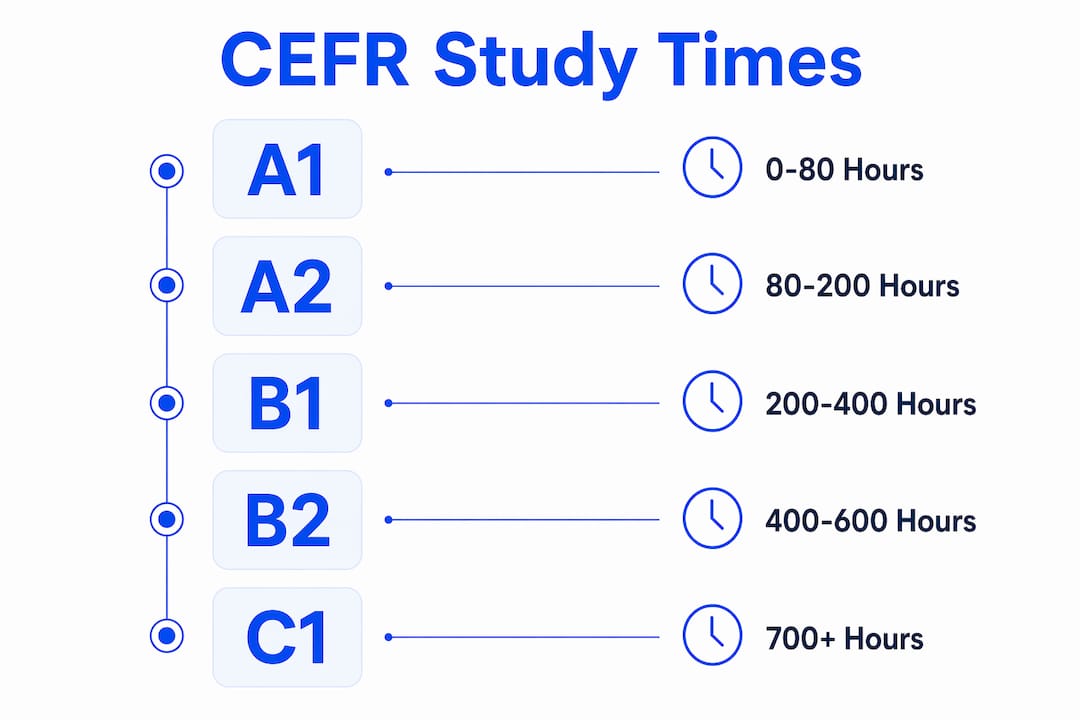
| CEFR Level | Cumulative Study Hours |
|---|---|
| A1 | 0–80 hours |
| A2 | 80–200 hours |
| B1 | 200–400 hours |
| B2 | 400–600 hours |
| C1 | 600–1,000 hours |
| C2 | 1,000+ hours |
These numbers assume structured, focused study. Passive exposure, such as watching Spanish TV without active engagement, counts for far less. A learner studying five hours per week reaches B1 in roughly one to two years. Reaching B2 adds another six to twelve months at the same pace.
The B1 plateau is real and well-documented. Many learners stall at B1 because survival-level Spanish feels sufficient for daily life. The jump from B1 to B2 requires deliberate practice on complex grammar, extended listening, and academic or professional vocabulary. Learners who push through this stage typically do so with structured courses and regular feedback from instructors.
C1 and C2 require more than hours. They require immersion, exposure to authentic materials, and the ability to think critically in Spanish. Reaching C2 typically surpasses 1,000 hours of total study, and most learners only achieve it through extended time in a Spanish-speaking environment. For most adult learners in Singapore, B2 or C1 is the realistic and rewarding ceiling.
Pro Tip: Track your study hours in a simple log. Seeing 300 hours accumulate is motivating. It also helps you predict when you will reach your next CEFR milestone.
Key Takeaways
The CEFR defines Spanish proficiency through six functional levels, and knowing where you stand on that scale is the single most useful thing you can do before choosing a course, setting a goal, or measuring your progress.
| Point | Details |
|---|---|
| Six clear levels | CEFR runs from A1 (beginner) to C2 (mastery), each with specific vocabulary and skill benchmarks. |
| Fluency starts at B2 | B2 marks the point where you can hold professional conversations and interact freely with native speakers. |
| Study hours matter | Reaching B2 requires roughly 400–600 cumulative hours of structured study. |
| B1 is the common plateau | Many learners stall at B1 and need targeted strategies or structured courses to push through. |
| CEFR is test-agnostic | The framework aligns with multiple Spanish exams, including DELE, making your level globally recognized. |
Why I think most learners misuse the CEFR
I have worked with adult Spanish learners across a wide range of starting points, and the most common mistake I see is treating CEFR levels as finish lines rather than checkpoints. A learner reaches B1, feels proud, and stops. Another learner fixates on C2 as the only acceptable goal and burns out somewhere around B2.
The CEFR works best when you use it to set goals that actually stick, not to judge yourself. The “can-do” statements are genuinely useful tools for self-assessment, but only if you engage with them honestly. Ask yourself: can I actually do this task in Spanish right now, or am I just familiar with the grammar rule behind it?
The other thing I tell every adult learner is this: functional language beats perfect language every time. A B2 speaker who talks to native speakers daily will outperform a C1 speaker who only studies textbooks. The CEFR measures communicative competence, and competence grows through use. Build your study plan around real conversations, real content, and real feedback. The levels will follow.
— Paul
Spanish Explorer courses built around your CEFR level
Spanish Explorer structures every course around CEFR proficiency levels, so you always know exactly where you are and what comes next. Whether you are starting from zero or pushing through the B1 plateau toward B2, the school’s certified instructors design lessons around functional communication, not grammar drills.

Adult learners in Singapore can choose from group classes, private sessions, and online Zoom formats, all mapped to CEFR stages. The school’s online Spanish classes are especially popular with working professionals who need flexibility without sacrificing structure. If you want a faster path to B2 or beyond, private Spanish classes let you move at your own pace with one-on-one instructor feedback. Explore the full range of Spanish courses at Spanish Explorer and find the format that fits your schedule and goals.
FAQ
What is CEFR for Spanish?
CEFR for Spanish is the Common European Framework of Reference for Languages applied to Spanish proficiency. It defines six levels from A1 (beginner) to C2 (mastery) based on what learners can do with the language in real situations.
What CEFR level is considered fluent in Spanish?
B2 is the standard for fluency, enabling free interaction with native speakers and comprehension of most media. C1 and C2 represent advanced and near-native mastery beyond conversational fluency.
How many hours does it take to reach B2 in Spanish?
Reaching B2 requires roughly 400–600 cumulative hours of structured study, according to CEFR benchmarks. The exact timeline depends on study intensity, learning format, and how much you practice outside the classroom.
Is CEFR used for Spanish exams like DELE?
Yes. The CEFR is a universal reference framework that multiple Spanish exams align to, including the DELE administered by Instituto Cervantes. Your CEFR level is therefore recognized across countries and institutions worldwide.
What vocabulary size do I need at each CEFR level?
Vocabulary requirements range from roughly 500 words at A1 to 16,000 words at C2. B2 requires around 4,000 words, which is the practical threshold for professional and social fluency in Spanish.
Recommended
- Spanish Language Proficiency Levels Explained for Adults
- What Is Intermediate Spanish? Your B1 Level Guide
- What Is Advanced Spanish? Skills, Levels, and Fluency
Start Learning Spanish Today
Book a trial class and see how quickly you can progress with a professionally trained native-speaker teacher guiding the way.
Book a Trial Class