 Spanish
TL;DR:
- A1 Spanish level is the official beginner stage that involves using basic phrases and understanding slow speech. It typically requires about 70 to 80 hours of focused study and covers 500 to 600 common words. Learners can introduce themselves, handle simple interactions, and rely on slow, clear speech from others.
A1 Spanish level is the official beginner proficiency stage defined by the Common European Framework of Reference for Languages (CEFR), representing the most fundamental ability to communicate in Spanish. At this stage, learners can use basic expressions, introduce themselves, and handle simple everyday interactions. Understanding what A1 means gives you a realistic picture of where you start, what you can do right away, and how to build from there. Spanish Explorer works with adult learners at exactly this stage, helping them move from zero to confident communication.
What is A1 Spanish level and what skills does it cover?
A1 Spanish level is defined as the ability to understand and use familiar, everyday expressions and very basic phrases. The CEFR framework places A1 at the entry point of a six-level scale that runs from A1 through C2. At this stage, you are not expected to hold a conversation about complex topics. You are expected to communicate in simple, predictable situations where the other person speaks slowly and clearly.

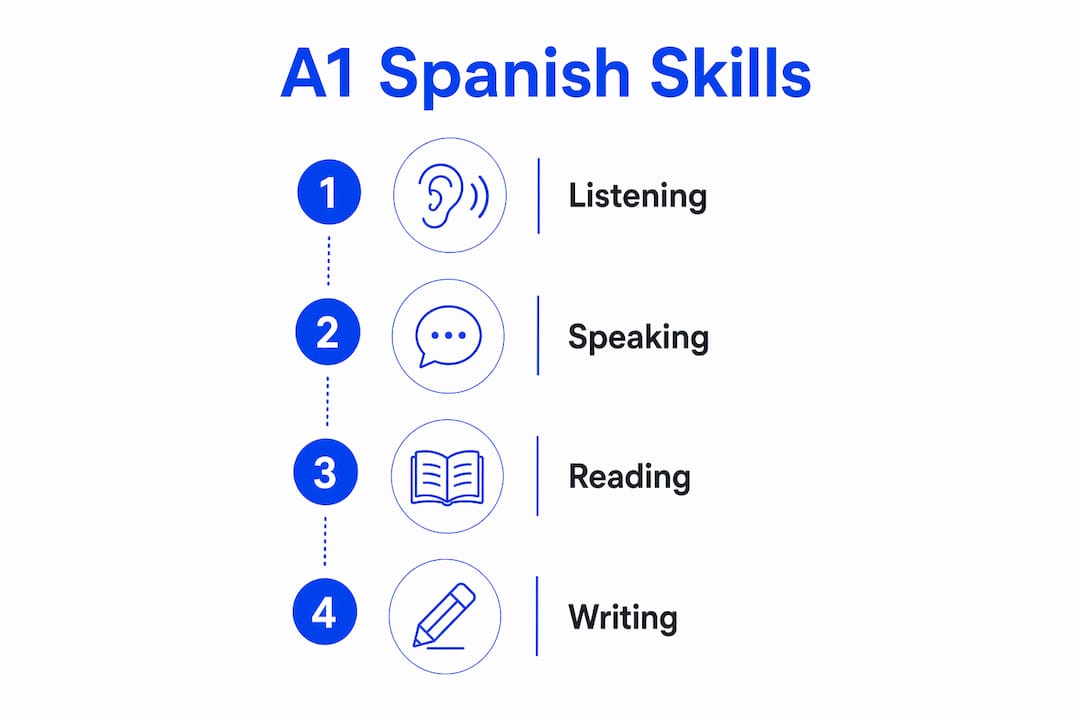
The four core skill areas at A1 are listening, speaking, reading, and writing. Each one has a specific, limited scope.
Listening: You can follow slow, clear speech in familiar contexts. Think of a hotel receptionist asking for your name, or a server listing today’s specials at a slow pace. You will struggle with fast, natural conversation between native speakers.
Speaking: You can introduce yourself and others, ask and answer simple personal questions, and use rehearsed phrases for greetings, directions, and basic requests. You are not improvising. You are deploying phrases you have practiced.
Reading: You can read very short, simple texts. Basic signs, menus, and simple messages fall within reach. The CEFR also notes that A1 learners can read simple children’s books and basic written messages.
Writing: You can write short, simple notes and fill in basic forms with personal details like your name, nationality, and address.
A1 vocabulary typically covers 500–600 words, focused on everyday topics like family, numbers, colors, food, and daily routines. That sounds small, but those words are chosen for maximum usefulness. You can check the Spanish vocabulary for daily use guide to see exactly which words matter most at this stage.
Pro Tip: Do not try to memorize every word in a beginner dictionary. Focus on the 200 most common Spanish words first. You will use them in nearly every sentence you ever speak.
How does A1 compare to other CEFR Spanish levels?
The CEFR defines six levels of language proficiency. A1 is the foundation stage that all higher levels build on. Each level above A1 adds complexity, speed, and range. Understanding where A1 sits helps you set realistic goals and plan your learning path.
The table below shows how A1, A2, and B1 differ across key skill areas.
| Skill area | A1 | A2 | B1 |
|---|---|---|---|
| Vocabulary | 500–600 words | 1,000–1,200 words | 2,000+ words |
| Listening | Slow, clear speech only | Familiar topics at normal pace | Most everyday conversations |
| Speaking | Rehearsed phrases and introductions | Short exchanges on familiar topics | Handles most travel and work situations |
| Reading | Basic signs, simple messages | Short texts on familiar topics | Straightforward texts on everyday subjects |
| Writing | Simple notes and forms | Short, simple connected text | Clear text on familiar topics |
A1 is not a stopping point. It is the first rung. A2 builds on A1 by expanding vocabulary and allowing more spontaneous exchanges. B1, the intermediate level, is where learners gain real independence in conversation. You can read more about that progression in this Spanish proficiency levels guide for adults.
The gap between A1 and A2 is smaller than most learners expect. Consistent practice of 30 minutes a day can move you from A1 to A2 within a few months. The gap between A2 and B1 is where most learners feel the real challenge begin.
What study strategies actually work at A1?
Reaching A1 proficiency is achievable with focused effort. The key is choosing the right methods from the start. Effective A1 learning avoids long lists of isolated vocabulary and instead builds around high-frequency, functional phrases you can use immediately. That shift in approach makes a measurable difference in how quickly you feel capable.
Here are four study strategies that work for adult beginners:
-
Learn phrases, not just words. “Me llamo Paul” (My name is Paul) is more useful than memorizing the word “llamar” in isolation. Phrases give you context, grammar, and confidence in one package.
-
Practice speaking from day one. Waiting until you feel “ready” to speak is the most common beginner mistake. Speaking early, even badly, builds the muscle memory and confidence that reading alone cannot. A beginner Spanish study plan can help you structure this from the start.
-
Listen to slow, clear Spanish daily. Podcasts designed for beginners, simple YouTube videos, and structured audio lessons all work. Your ear needs repetition to recognize sounds before your brain can process meaning.
-
Set small, specific goals. “Learn to order food in a café” is a better goal than “learn Spanish.” Specific goals give you a clear finish line and a real sense of progress when you cross it.
Pro Tip: Record yourself speaking a new phrase on day one, then again after two weeks. Hearing your own improvement is one of the most powerful motivators in language learning.
An A1 learner can typically reach this level after around 70–80 hours of focused study. That is roughly four to six months of regular classes combined with daily practice. Structured instruction accelerates that timeline significantly compared to self-study alone.
What can you realistically do with A1 Spanish?
A1 Spanish gives you real, usable communication ability in a narrow but practical range of situations. The key word is “narrow.” Knowing what A1 can and cannot do helps you use it confidently without setting yourself up for frustration.
Situations where A1 Spanish works well:
- Introductions and greetings. You can say your name, where you are from, what you do, and ask the same of others.
- Ordering in a café or restaurant. Typical A1 interactions include ordering food and drink, asking for the bill, and understanding simple responses.
- Basic shopping. You can ask for prices, say what you want, and understand simple numerical answers.
- Simple travel situations. Asking for directions, understanding basic signs, and checking into a hotel are all within reach.
- Brief professional introductions. In a business context, you can introduce yourself and your company in a short, prepared statement.
The key limitation at A1 is dependency. You depend on the other person speaking slowly, clearly, and using simple words. The moment a native speaker shifts to natural conversational speed, A1 learners typically lose the thread. That is not a failure. It is a defined characteristic of the level.
A1 is sufficient for very brief tourism interactions and introductory business scenarios where the exchange is scripted or predictable. For anything more complex, A2 or B1 is required. Cultural immersion travel, such as a trip to Spain, can accelerate your progress beyond A1 faster than classroom study alone because it forces real-world application every day.
Key Takeaways
A1 Spanish level is the CEFR’s defined entry point for Spanish proficiency, covering a vocabulary of 500–600 words and the ability to communicate in simple, predictable everyday situations with support from slow, clear speech.
| Point | Details |
|---|---|
| A1 is CEFR’s entry level | It defines the minimum ability to communicate in simple, everyday Spanish contexts. |
| Vocabulary scope is focused | A1 covers 500–600 words chosen for maximum everyday usefulness. |
| Speaking depends on slow speech | A1 learners need others to speak slowly and clearly to follow the conversation. |
| Phrase-based learning works best | Learning functional phrases outperforms memorizing isolated vocabulary lists. |
| 70–80 hours reaches A1 | Focused study of around 70–80 hours is typically enough to reach A1 proficiency. |
Why A1 surprised me every time I taught it
The most common thing I hear from beginners after their first few weeks is, “I didn’t think I’d be able to say that much.” That reaction never gets old. A1 is often underestimated because the vocabulary count sounds tiny. Five hundred words feels like nothing when you compare it to the tens of thousands of words an educated adult knows in their native language.
But here is what that comparison misses. Those 500 words are not random. They are the words that appear in nearly every conversation you will ever have. “Hello,” “please,” “where is,” “how much,” “my name is.” You can string those together into dozens of useful sentences before you ever open a grammar textbook.
The learners who struggle at A1 are almost always the ones who wait to speak until they feel ready. They study, they review, they listen. But they do not open their mouths until they feel confident. Confidence does not come before speaking. It comes from speaking. The role of real interaction in building that confidence is something no app can fully replace.
My advice is simple. Use your A1 Spanish with a real person as soon as you have your first ten phrases. Order a coffee in Spanish. Introduce yourself to someone. Make the mistake, laugh about it, and do it again. A1 is not a waiting room before real Spanish learning begins. It is real Spanish learning.
— Paul
Spanish Explorer’s beginner courses for A1 learners
Spanish Explorer offers structured beginner courses designed specifically for adult learners starting from zero. Whether you prefer group classes, private sessions, or online learning via Zoom, the curriculum builds A1 skills systematically through certified instruction in both Spanish and English.
Every course at Spanish Explorer is built around real communication from the first lesson. Instructors are certified, bilingual, and experienced with adult learners pursuing Spanish for personal enrichment, travel, or professional use. Group classes build conversational confidence, while private Spanish classes let you move at your own pace. You can also explore the full range of Spanish courses to find the format that fits your schedule and goals. The school is located at 10 Anson Road, level 22, International Plaza, Singapore 079903, right above Tanjong Pagar MRT.
FAQ
What is A1 Spanish level in simple terms?
A1 Spanish level is the beginner stage of the CEFR framework, where learners can use basic phrases, introduce themselves, and understand slow, clear speech in everyday situations.
How long does it take to reach A1 Spanish?
Most learners reach A1 after around 70–80 hours of focused study, which typically translates to four to six months of regular classes combined with daily practice.
What vocabulary do I need for A1 Spanish?
A1 Spanish requires a working knowledge of 500–600 words, covering everyday topics like greetings, numbers, family, food, and basic directions.
Can I use A1 Spanish in a professional setting?
A1 is sufficient for brief, scripted professional introductions, but it is not enough for business meetings or extended workplace conversations. A2 or B1 is the practical minimum for professional use.
How do I know if I am at A1 level?
You are at A1 if you can introduce yourself, ask and answer simple personal questions, and understand a native speaker who speaks slowly and clearly. A structured beginner Spanish grammar review can help you confirm your baseline.
Recommended
- What Is Intermediate Spanish? Your B1 Level Guide
- What Is a Spanish Placement Test? A Clear Guide
- Learn Spanish Timeline: A Realistic Guide for Singapore Learners
- Spanish Language Proficiency Levels Explained for Adults
Start Learning Spanish Today
Book a trial class and see how quickly you can progress with a professionally trained native-speaker teacher guiding the way.
Book a Trial Class