 Spanish
TL;DR:
- Effective Spanish revision combines active recall and spaced repetition across all four skills to build lasting fluency.
- Short daily practice sessions are more effective than infrequent, lengthy ones, because they aid brain consolidation.
Effective Spanish revision steps are structured methods that combine active recall, spaced repetition, and balanced skill practice to build lasting fluency. Most learners waste time re-reading notes or passively watching videos, activities that feel productive but rarely translate into real ability. The best revision methods for Spanish treat all four skills — vocabulary, grammar, listening, and speaking — as equally important and equally trainable. Follow the steps in this guide and you will build a structured Spanish study process that produces measurable results.
What are the most effective Spanish revision steps?
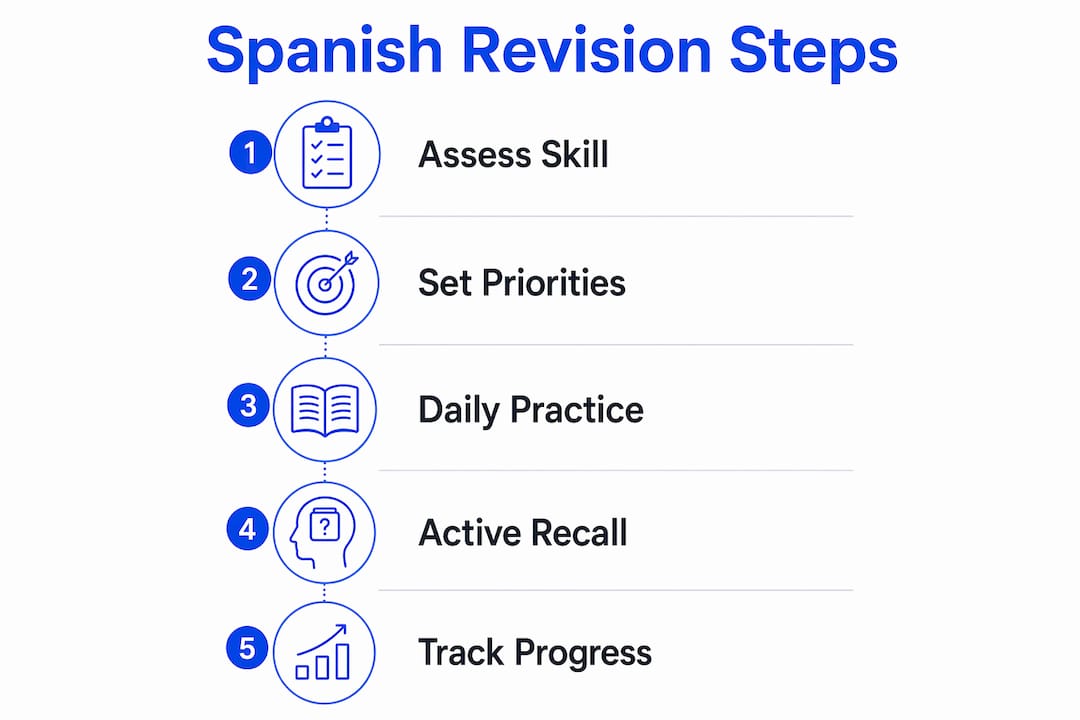
Effective Spanish revision starts with knowing exactly where you stand. Without a clear baseline, you risk spending hours on skills you have already mastered while neglecting the ones holding you back.
Here is how to assess your level and build a focused plan:
- Test all four skills separately. Rate yourself on listening, speaking, reading, and writing using a simple 1–5 scale. Be honest. Most learners overestimate speaking and underestimate reading.
- Use a free proficiency self-assessment. The Common European Framework of Reference (CEFR) descriptors give you clear, skill-specific benchmarks from A1 through C2. Read the descriptors for each level and mark where your abilities actually sit.
- Record a two-minute spoken summary. Pick a topic you know well and speak freely for two minutes. Play it back and note where you hesitate, mispronounce, or lose grammar accuracy. This is your speaking baseline.
- Write a short paragraph from memory. Summarize something you read or heard recently without looking at notes. Count how many grammar errors you make and which types repeat.
- Document everything in a spreadsheet. Log your self-ratings, test scores, and observations by date. This record becomes your revision compass.
Once you have your baseline, you can prioritize. A learner who scores well on reading but struggles with speaking needs a very different plan than one who understands grammar rules but cannot recall vocabulary under pressure. Tailoring your revision to your actual gaps is what separates fast progress from slow drift.
How should you structure daily Spanish revision sessions?
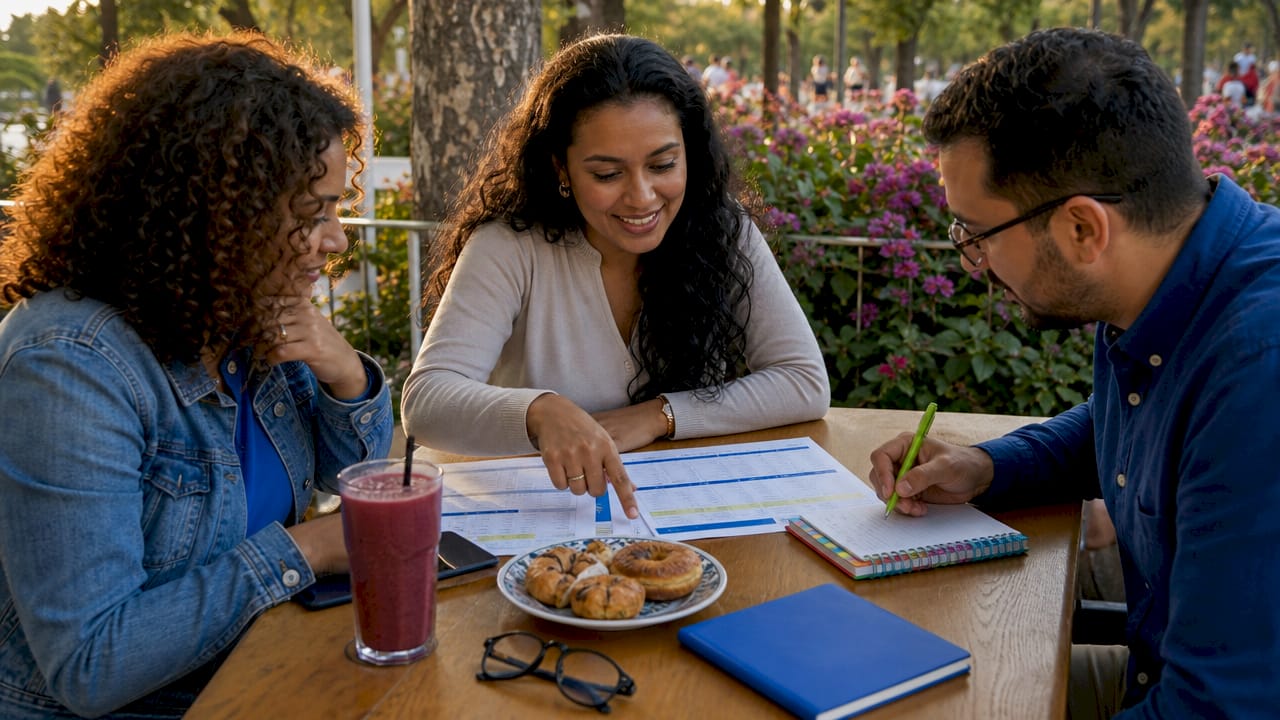
Short daily sessions are the primary driver of sustained language progress. A focused 20–30 minute session every day outperforms a three-hour session once a week because your brain consolidates language during sleep and rest between sessions.
Structure your daily practice around these four areas:
- Vocabulary review (7–10 minutes). Use spaced repetition to revisit words you are close to forgetting. Active recall techniques force genuine engagement and strengthen long-term memory far more than re-reading word lists.
- Grammar focus (5–7 minutes). Pick one concept per session. Practice it with three to five original sentences you write yourself, not exercises from a textbook.
- Listening or reading (5–7 minutes). Consume content one level below your current ability. Take brief notes in Spanish while you listen or read.
- Speaking or writing output (5–7 minutes). Summarize what you just heard or read aloud, or write three sentences using the grammar point you practiced.
Adjust these time blocks based on your assessment results. If speaking is your weakest skill, swap the listening block for an extra speaking block two or three times per week.
Interleaved practice, which means mixing different topics or skill types within one session, promotes deeper cognitive engagement than drilling one topic repeatedly. Your brain learns to recognize when and how to apply rules, which is exactly what real conversation demands.
Pro Tip: Set a fixed time each day for Spanish practice, even if it is only 15 minutes. Consistency at a lower volume beats intensity without regularity every time.
Avoid overambitious schedules. Rigid study plans that leave no room for life’s interruptions are the leading cause of learners quitting. Build in one flexible day per week where you can shift the session without guilt.
How do you revise Spanish vocabulary and grammar effectively?
Passive review, such as highlighting notes or re-reading vocabulary lists, creates a false sense of familiarity. Active retrieval outperforms passive review by forcing your brain to reconstruct information rather than simply recognize it.
Vocabulary revision that sticks
Spaced repetition systems like Anki or Quizlet schedule reviews at the exact moment your memory is about to fade. That mental effort to retrieve a nearly forgotten word is not a sign of failure. It is the mechanism that strengthens memory for the long term. Add each new word in a full sentence that reflects a situation from your real life. “I ordered coffee at the airport” is more memorable than a bare translation.
Aim to learn vocabulary in thematic clusters. Words for travel, work meetings, or daily routines stick together because your brain stores them with shared context. Isolated word lists have no such anchor.
Grammar revision that transfers to speech
Focus on one grammar concept per session and practice it through production, not recognition. Write five sentences using the subjunctive mood, then say them aloud. Check your work against a reference, correct your errors, and write the corrected version again. This three-step cycle (produce, check, correct) builds accuracy faster than any amount of reading about grammar rules.
Build a personal grammar reference guide in a notebook or document. Write the rule in your own words, add two examples you created yourself, and note the errors you made. Reviewing this guide weekly reinforces the concepts that matter most to you.
Pro Tip: Focus on Spanish grammar for fluency by learning rules in context. Grammar studied in isolation rarely transfers to real conversation.
| Revision method | What it trains | Best used for |
|---|---|---|
| Spaced repetition flashcards | Long-term vocabulary recall | New and recently learned words |
| Sentence writing from memory | Active grammar application | Tenses, moods, and verb conjugations |
| Error correction log | Accuracy and self-awareness | Recurring grammar mistakes |
| Thematic word clusters | Contextual vocabulary use | Topic-specific conversations |
What active methods improve Spanish listening and speaking skills?
Many learners neglect speaking during revision, and confidence suffers as a result. Listening and speaking are the two skills most directly tied to real-world communication, yet they receive the least structured attention in most self-study plans.
Active listening and speaking practice looks like this:
- Listen with a task. Play a Spanish podcast or audio clip and pause every two minutes to summarize what you heard in your own words. This forces comprehension rather than passive exposure.
- Record yourself speaking. Choose a topic, speak for 90 seconds without stopping, then play it back. Note three specific things to improve: pronunciation, vocabulary gaps, or grammar errors. Repeat the recording after addressing those points.
- Use language exchange platforms. Platforms that connect you with native speakers for conversation practice give you real-time feedback that no app can replicate. Even one 30-minute conversation session per week produces measurable gains in fluency.
- Start below your comfort level. Content that is slightly easier than your current level builds listening speed and confidence. Once you can follow 90% of a podcast without pausing, move up one level.
- Practice Spanish speaking skills with structured prompts. Give yourself a topic, set a two-minute timer, and speak until it stops. Treat silence as a problem to solve, not a reason to quit.
Passive consumption like watching Spanish TV without active engagement feels productive but does not build fluency. Speaking and writing force active retrieval, which is the mechanism behind real language acquisition. Every time you produce language rather than consume it, you close the gap between understanding and fluency.
Overcoming speaking anxiety takes gradual exposure. Start by talking to yourself in Spanish during daily tasks. Narrate what you are doing while cooking or commuting. This low-stakes practice builds the habit of thinking in Spanish before you ever speak to another person.
How do you track progress and adjust your Spanish study plan?
Progress tracking prevents the most common cause of learner plateaus: continuing to do what feels comfortable rather than what produces growth. Consistent progress tracking tells you when to change strategies before frustration sets in.
Pro Tip: Retest your skills every 4–6 weeks using the same assessment you used at the start. Comparing results against your original baseline shows real growth and reveals which areas still need attention.
Use this simple tracking structure:
| Tracking method | Frequency | What to measure |
|---|---|---|
| Vocabulary count log | Weekly | Number of words actively recalled without prompts |
| Speaking recording review | Bi-weekly | Fluency, pronunciation, and grammar accuracy |
| Grammar error log | After each session | Types and frequency of repeated mistakes |
| Full skill self-assessment | Every 4–6 weeks | CEFR-level ratings across all four skills |
When your scores improve in one area but stall in another, shift your daily time allocation. If reading comprehension has plateaued, add a second reading session per week and reduce time on vocabulary drills temporarily. Flexible timing with consistent goals is the structure that sustains long-term progress.
Recognize that language development does not move in a straight line. Weeks where you feel stuck often precede noticeable breakthroughs. The effort to recall difficult material is exactly what builds the neural connections that make language feel automatic over time.
Key Takeaways
Effective Spanish revision combines daily active practice, skill-specific assessment, and consistent progress tracking to build real fluency across all four language skills.
| Point | Details |
|---|---|
| Assess before you revise | Rate all four skills using CEFR benchmarks to identify your actual gaps. |
| Daily short sessions win | 20–30 minutes of focused daily practice outperforms occasional long study marathons. |
| Active recall beats passive review | Use spaced repetition and sentence production instead of re-reading notes. |
| Speaking needs deliberate practice | Record yourself, use language exchange, and narrate daily tasks to build fluency. |
| Track and adjust every 4–6 weeks | Retest skills regularly and shift time allocations based on what the data shows. |
What I have learned about Spanish revision that most guides skip
The most common mistake I see is treating revision as a reading exercise. Learners fill notebooks with grammar rules, re-read vocabulary lists, and feel busy. But busyness is not progress. The moment you shift from consuming information to producing it, everything changes.
Speaking practice is the skill most learners delay the longest, and it is the one that pays off fastest. Recording yourself feels uncomfortable at first. Play it back anyway. You will hear exactly what a native speaker hears, and that honest feedback is worth more than any textbook correction.
Frustration during revision is a signal, not a stop sign. When you struggle to recall a word or construct a sentence, your brain is working harder than it does during easy review. That effort is the learning. Embrace the difficulty rather than switching to easier material the moment things get hard.
The learners who make the fastest progress are not the ones who study the most hours. They are the ones who study with the clearest purpose, adjust when something stops working, and keep showing up even when progress feels invisible.
— Paul
Spanish Explorer’s courses for structured revision
Spanish Explorer offers adult Spanish courses in Singapore designed for conversational and business use, with flexible options including group classes, private instruction, and online learning via Zoom. Every course follows a curriculum built around practical communication skills, giving you the structured framework that self-study alone rarely provides.

Whether you are building from scratch or refining existing skills, Spanish Explorer’s Spanish courses give you access to certified instructors who are fluent in both Spanish and English. That bilingual instruction means grammar explanations land clearly and speaking practice gets real feedback. For learners who want a faster path with personalized attention, private Spanish classes let you focus exactly where your assessment shows you need it most. Classes are held at International Plaza, 10 Anson Road, Level 22, Singapore 079903, directly above Tanjong Pagar MRT.
FAQ
What are the most effective Spanish revision steps for adults?
The most effective steps are baseline assessment, daily 20–30 minute sessions using active recall and spaced repetition, and skill-specific practice across vocabulary, grammar, listening, and speaking. Tracking progress every 4–6 weeks keeps the plan aligned with your actual development.
How often should I revise Spanish to see real progress?
Daily practice, even in short sessions, produces better retention than infrequent long sessions. Consistent daily exposure allows your brain to consolidate language during rest periods between sessions.
Why is speaking practice so important during Spanish revision?
Neglecting speaking causes anxiety to build and fluency to stall. Active speaking forces retrieval and production, which are the core mechanisms of real language acquisition.
What is spaced repetition and how does it help Spanish revision?
Spaced repetition schedules vocabulary and grammar reviews at the moment your memory is about to fade. That retrieval effort strengthens long-term memory more effectively than any passive review method.
How do I know when to adjust my Spanish study plan?
Retest your skills every 4–6 weeks and compare results against your original baseline. When one skill stalls while others improve, shift your daily time allocation toward the area that needs more attention.
Recommended
- Master an Efficient Workflow for Learning Spanish Online
- How to Write in Spanish: A Practical Guide for Adults
- Your Structured Spanish Study Process: A Step-by-Step Guide
- Your Spanish Language Practice Workflow for Real Fluency
Start Learning Spanish Today
Book a trial class and see how quickly you can progress with a professionally trained native-speaker teacher guiding the way.
Book a Trial Class